Showing posts with label David Gonzalez. Show all posts

Monday, December 2, 2019

MEXICAN LEAGUE CHOOSES NEW PRESIDENT

Mexican League president Horacio de la Vega
The Mexican League has named Horacio de la Vega as their new president.  The 44-year-old de la Vegas is a Mexico City native and two-time Olympic pentathlete for Mexico (1996 and 2000) with a Masters degree in Business Administration from the University of Texas and has an extensive background in sports.  He'll replace Javier Salinas, a former Liga MX pro soccer marketing executive who served as LMB president for two years before leaving office following the 2019 season.

De la Vega was the Commercial and Marketing Director for the 2011 Pan American Games in Guadalajara prior to serving as General Director of Sports in Mexico City, helping coordinate events involving the NFL, MLB, NBA, PGA, UFC and Formula One organizations, among others.  During his time in Mexico City, according to an LMB press release, de la Vega oversaw more than 35 international sporting events per year along with about 400 local or national events. 

LMB Home Run Derby in Mexico City Zocalo
He was Mexico City Commissioner for the Formula One Grand Prix of Mexico, general coordinator for the 2016 MLB Mexico Series between the San Diego Padres and Houston Astros and Fray Nano Stadium, one of the main drivers of the 2015 Mexican League Home Run Derby in Mexico City's Zocalo (the first time a public square was converted into a ballpark) and helped stage NFL and NBA games in Mexico City.  De la Vega was also president of the organizing committee for the 50th Anniversary celebration of the 1968 Summer Olympics in Mexico City.  He most recently was a senior advisor for the 2019 Pan American Games in Lima, Peru.

De la Vega will take the Mexican League reins from longtime Liga executive Gabriel Medina, who served as interim president after the LMB and Salinas parted ways.  He'll inherit a 16-team circuit in which many franchises are bleeding red ink with teams playing in front of sparse crowds, although the league did top five million in attendance for the first time since before the turn of the 21st Century.  The vote to name the former National Sports Award winner as a pentathlete reportedly involved all teams, a change from Salinas' 2017 selection originating from just three owners.


CHARROS WIN 7 OF FIRST 8 GAMES TO OPEN LMP SECOND HALF

Jalisco Charros outfielder Dariel Alvarez
The Jalisco Charros had a good first half to their Mexican Pacific League season, finishing one game behind first place Obregon with a 21-14 to come in third, garnering eight playoff points in the bargain.  Now the Guadalajara side has broken out the second-half gate in a big way by winning seven of their first eight games to take a two-game lead over the 5-2 Mexicali Aguilas, who are trying to rebound from an 18-24 showing in a first half that saw manager Bobby Dickerson fired and replaced by Pedro Mere (whose coaching staff includes former skippers Eddy Castro, Bronswell Patrick and Adan Munoz, who was canned as Navojoa helmsman in the first half).

Back to Jalisco, the defending champions have shown well under manager Roberto Vizcarra.  The Charros have a veteran roster that includes catcher Bruce Maxwell, infielders Stephen Cardullo, Manny Rodriguez, Amadeo Zazueta and Agustin Murillo plus outfielders Carlos Figueroa, Henry Urrutia and Dariel Alvarez.  Four Jalisco everyday starters are batting over .300, led by Zazueta's .350 average and Figueroa at .333.  Much of the power has been supplied by Alvarez, whose team-leading eight homers and 33 RBIs supplement his .295 average.  The Cuban-born rightfielder played six winters in that country's National Series before signing with Baltimore in 2013 (and eventually had two cups of coffee with the Orioles).  Alvarez is not regarded as a power hitter, per se, but he's found his groove in Guadalajara after belting 14 roundtrippers for the Charros last season to finish second in the MexPac behind the 15 of Navojoa's Joan Rosa.

Jalisco left-handed pitcher Marco Tovar
Jalisco's pitching staff isn't as star-studded as their daily lineup, with a team ERA of 3.88 in the bottom half among the LMP's ten teams, but Guadalajara is not the easiest place to pitch with its high altitude so those numbers can be a little deceiving at first glance.  The best starter thus far this season has been lefty veteran Marco Tovar, whose 3-2 record hides an ERA of 2.19 that ranks fourth among qualifying MexPac hurlers.  Tovar is a 30-year-old Tijuana product who's pitched in five Mexican League All-Star Games and was named the LMB's Pitcher of the Year in 2011 after going 12-4 for Reynosa that summer.  Among other Jarros starters, import Mitch Atkins, who pitched in several minor league All-Star Games and had two short stints with the Chicago Cubs in 2010 and 2011, is 4-3 with a 2.80 ERA (8th in the LMP) while Octavio Acosta has a perfect 4-0 record and a 4.03 ERA (12th in the loop).  If the Charros have a weak spot, it's in the bullpen.  Although closer Grant Sides is sixth in the league with seven saves, the former Indians farmhand isn't likely writing home about his 12.75 ERA or opponents' batting average of .373.  Even so, you have to outscore your opponents to win a baseball game and the Charros have shown the offense to continue doing just that and are in good position to repeat as LMP champions.

The aforementioned Zazueta (he of the .350 average) now leads the MexPac in hitting, twelve points ahead of Christian Zazueta's .338 for Navojoa.  Culiacan's Seastian Elizalde, Leandro Castro of Los Mochis and Monterrey's Michael Choice are all tied for the lead in homers with 10 each while Jalisco's Alvarez and Jesus Valdez of Obregon both top the RBI table with 33.  Rico Noel of Culiacan recently stole five bases in a seven-game stretch to bring his season total to 20 swipes in 24 attempts, well ahead of the 13 apiece for Elizalde and Obregon's Taiki Sekine.

Los Mochis starting pitcher Yoanys Quiales picked up his first win since November 15 last Wednesday in Mazatlan to go to 7-1 for the season, comfortably ahead of eleven pitchers who have four wins each.  One of them, Mike Kickham of Hermosillo, is tops in ERA at 1.96, with Mexicali's Greg Mahle in second at 2.01.  Another four-win pitcher, Obregon's Brazilian starter Andre Rienzo, heads the strikeouts table with 51 ponches, six more than Quiales and Juan Pablos Oramas of Hermosillo.  An Oramas teammate, Trey McNutt, is tied with Jose Rosario of Guasave with an LMP-best 11 saves while Obregon's Samuel Zazueta is best with 11 holds.  It does not appear that any of the three Zazuetas are related.


LIGA NORTE EXPANDS TO SIX TEAMS; TWO MORE ON WAY?

The Northern Mexico League has added an expansion franchise with the Otay Industriales set to join the Class AA circuit in time for the 2020 season.  At a recent LNM presidents meeting in Tijuana, five existing teams confirmed their participation next year, including the San Quintin Freseros, Caborca Rojos, Ensenada Marineros, La Paz Delfines and the defending champion San Luis Algodoneros.  However, the main topic moving forward was expansion, with Otay brought into the fold and talk of two more new franchises to turn the LNM into an eight-team loop next season.

Mesa de Otay is not an independent city but rather a section of Tijuana, Baja California Norte.  The Industriales will not play in Tijuana's Mexican League ballpark currently used by the Toros during the spring and summer.  Instead, they'll play in Estadio Angel Camarena, a smaller facility where former MLB All-Star first baseman Adrian Gonzalez cut his teeth as a young player, according to El Titan's father David.  The elder Gonzalez is now general director of B.C. Norte's Institute of Sports and Physical Culture, and will help coordinate what is being called "a significant investment" in  the ballpark's remodeling, to be completed by next April, prior to the 2020 LNM schedule.

B.C. Norte governor Jaime Bonilla's first pitch
Gonzalez was joined by Baja California Norte governor Jaime Bonilla, who tossed a ceremonial first pitch before the inaugural game of the Tijuana Amateur Baseball League in late October.  The renovations were announced weeks before the new Liga Norte franchise was granted to Otay, but the two are undoubtedly linked to each other.

Representatives of a second possible team in Baja California Sur were on hand at the meeting.  The LNM made its debut in that state last season when the La Paz Delfines took the field.  No word on where a second team there would be located; the Los Cabos region is the only area with the population to support a franchise but the Mexican League Quintana Roo Tigres could probably testify that selling tickets to baseball games in a tourist center is not the easiest thing to do.  Another potential expansion site was termed "an old acquaintance in the league" in a story posted on Puro Beisbol, but no further details could be given for now.

The Liga Norte also gave Tuesday, April 14 as their 2020 season inaugural date.  If eight teams indeed play next year, each would play an 84-game schedule with the season wrapping up the second week of August.  The LNM is still searching for an executive president, but that topic was tabled at the recent meeting.  The president of the league's Board of Directors, San Luis Algodoneros owner Francisco Montano, has sat behind the big desk the past two years.


Notice to Readers: BBM to go monthly on interim basis

This will be the only Baseball Mexico scheduled to be posted in December.  I'm moving from the U.S. Pacific Northwest to the Philippines this week and will need some time to somehow get settled during the holiday season.  I'm moving to Baguio, a city of 370,000 with ten universities nestled nearly 5,000 feet above sea level in the Cordillera Mountains.  Baguio is noted for its relatively cool temperatures and is nicknamed "The Summer Capital of the Philippines" for that reason.  

Jose Rizal Memorial Baseball Stadium, Manila
They do play baseball in the Philippines, by the way, but only at the amateur or scholastic level. There IS a great old 12,000-seat ballpark in Manila named Jose Rizal Memorial Baseball Stadium, where the first homers hit after its 1934 opening were by guys named Lou Gehrig and Babe Ruth (you may have heard of them), and I would like to catch at least a couple ballgames there while it's still standing.

Anyway, Baseball Mexico will hopefully be back to a weekly basis by February 2020, just in time for the Caribbean Series.  I'll try to post unscheduled updates between now and February when I can, but I expect to be a little preoccupied until then.

Monday, July 18, 2016

Cesar Tapia's amazing year continues in Puebla

If you'd never heard of Cesar Tapia prior to the current Mexican League season, you'd hardly be in exclusive company.  In fact, despite career statistics that would usually bring the kind of acclaim that lesser players have received, the Puebla Pericos' 12-year veteran catcher is still a relative unknown even inside Mexico, although that perception may be finally starting to change.

The 33-year-old Tapia (pictured), who has spent all but one of the past twelve summers in Puebla, went 11-for-19 (.579) with seven RBI's and six runs scored in five games last week to raise his season batting average to .387, good for a 21-point lead over Veracruz outfielder Carlos Lopez' .366 mark in the Liga batting race.  Barring a meltdown over the final four weeks of the regular season, Tapia is the odds-on favorite to win his first batting crown for the career .330 batsman.  "Wait a minute," you may be wondering, "he's a catcher with a .330 average after twelve seasons?  Why haven't I heard of this guy before?"  Tapia has good reason to ask that question himself.

Born November 10, 1982 in Empalme, Sonora, Cesar Tapia Figueroa grew up around the game, as so many youngsters in that baseball-crazy part of Mexico do, when he attended a Pericos tryout in 2000 to which one of his friends had been invited.  Former Detroit shortstop Cesar Gutierrez, who was overseeing the tryouts for Puebla, asked Tapia if he'd like to join in and ended up signing the 17-year-old to a contract.  Tapia then had to spend most of four seasons playing A and AA ball in the Mexican minors, often having to share houses with all his teammates while searching for a permanent defensive position.  He finally reached Puebla in 2004 and, except for spending the 2006 campaign with the Angelopolis Tigres, has been in the Pericos' green-and-gold togs ever since.

Not that many outside Puebla have noticed.  After batting .229 as a Pericos part-timer in 2005, he hit .301 in his lone Tigres season and has fallen below .300 only once since returning to Puebla in 2007.  Despite consistently batting in the .330-.350 range with moderate extra-base power (Tapia had 227 career doubles and 87 homers through last weekend), he has only been picked for three All-Star Games, including last month in Monterrey.  Tapia has also been obscured by the Pericos' relative lack of success, as Puebla has reached the championship Serie del Rey twice, losing to Saltillo in five games in 2010 and getting swept by Mexico City in 2014.

The relative obscurity Tapia has toiled in for over a dozen years is finally giving way to some attention outside Puebla, where he is the franchise's all-time leader with 214 doubles and ranks among the leaders in several other categories.  Aside from his .387 average, the 5'11" 200-pounder nicknamed "El Natural" has already set career highs with 16 homers and 11 stolen bases (the first time he's ever swiped more than five sacks in a season) with a month to go.  As well, with Puebla holding the Liga's best record at 62-26 and a 2.5-game lead in the LMB South Division, Tapia and the Pericos are a valid pick to bring home the team's first pennant since 1986, which would undoubtedly bring him more attention.

But even if his amazing 2016 campaign didn't result in a noticeable uptick in the amount of attention he's deserved, you get the sense that little would change with Cesar Tapia's approach to the game.  "You just come every day with the mentality of being well-prepared and giving 100 percent all game, not just a few innings...we owe it to the public, the people who come to the game and buy tickets."


Culiacan Academy opens with MLB VP in attendance

Anybody familiar with baseball in Latin American countries are probably well aware that academies for young prospects are almost ubiquitous.  Major League Baseball teams commonly operate academies in nations like Venezuela and the Dominican Republic (the independent movie "Sugar" is a terrific primer in how Latino teens work their way through the system), but no MLB-owned facility has existed in Mexico even though academies have been popping up here and there south of the border.  However, a step in that direction may have been taken with the recent opening of an academy in the Sinaloa city of Culiacan.

Although MLB is not involved with the Sinaloa Baseball Academy & Interactive Museum in a proprietary role, they will serve in a direct advisory capacity, marking the first time the big leagues have had an active hand in developing teen talent in Mexico.  MLB's Vice President for International Operations, Kim Ng, was on hand for inaugural ceremonies on July 8.  Speaking to those gathered, Ng said, "I'm very happy to be with you on behalf of Major League Baseball.  For my part, I'm very happy to be part of something that will be good for Mexico and MLB.  This program is the first of its kind."

Mexican Pacific League president Omar Canizales remarked, "We're all present here because we love baseball, and this unites us because it'll lead us to make baseball bigger."  Canizales also addressed his Mexican League counterpart, outgoing president Pinio Escalante, saying "We need to work hand in hand.  The governor (Mario Lopez Valdez) has united us around this table and this great project.  I think we have a huge responsibility to find points of agreement to grow Mexican baseball."

That latter goal may be difficult to achieve.  The Mexican League has operated its own academy near Monterrey for two decades as part of the control it has exercised over player rights in the country.  Historically, young prospects have signed contracts with Mexican League teams who routinely ship them to the LMB Academy for seasoning before moving them up to Class A or AA teams within the LMB system to determine whether they're ready to play in the Liga.  The LMB has had a virtual monopoly over rights to Mexican players (that last that player's entire career within Mexico), and fees are routinely charged to Major League organizations for the right to negotiate contracts with those players.  Sometimes those fees are too high for MLB teams, who will instead spend a similar amount to sign multiple prospects in other countries.  The result is that several Mexican youngsters with some MLB potential have never been able to head north to further their careers.

The entry of MLB, even peripherally, could alter that dynamic.  There have been attempts at rival academies challenging the Mexican League's hegemony over domestic talent in the past, most notably one east of San Diego owned and operated by Dodgers All-Star first baseman Adrian "El Titan" Gonzalez, his brother Edgar (now Mexico's National Team manager) and their father David, a longtime Mexican baseball figure, but that did not last.  However, direct involvement by MLB in player development south of the border could be a game-changer regarding contractual rights to prospects.  We shall see.


BBM to produce book on Mexican baseball legends

Okay, rather than put together a story where I talk about myself in the third-person (included quoting myself), let's break down the fourth wall for a few lines.  The book that I recently finished about the history of the Seattle Rainiers team that spent five seasons in the Class A Northwest League during the Seventies is done after starting it as a one-page master roster sheet four decades ago.  The finished product is 108 pages long (covers included), I'm reasonably happy with it and am now in the process of figuring out how to sell enough copies at $12 apiece to cover the cost of printing.  It's titled "Anonymous Heroes: Seattle Rainiers baseball in the 1970's" and if you're interested, email me at SeattleRainiers@outlook.com for details.

Although I'm currently focused on selling the Rainiers book, I'm starting to put together another book with two-page profiles, pictures and stats (where applicable) commemorating 50 of the most important players, owners and writers in modern Mexican baseball history.  The working title is "The Golden Greats of Mexican Baseball" and will be very loosely based on the "Maestros of Mexico" profiles on prominent Mexican baseball figures that I used to write for the old Viva Beisbol site and column.  I expect this book will be in the neighborhood of 120 pages and be published as a digest-sized 5.5" x 8.5" paperback.

Actually, there will be 51 people profiled in "Golden Greats."  I want to give Hector Espino a separate section of his own apart from the 50 others because, well, he's Hector Espino, who I consider a combination of power and pride who really has no counterpart in Mexican baseball history.  Imagine a hybrid between Babe Ruth and Roberto Clemente or Jackie Robinson and you start to get the picture.  I've got the 37 profiles I wrote for VB back in the day with wildly-varying degrees of length and focus that'll need to be revamped into uniform word count (400-500?) and purpose with another 14 people added.  I'd love to have this ready in time for Christmas, but I don't want to rush it into production if it means lesser quality.  I may not take myself too seriously, but I take what I do here VERY seriously and I want to get this right.

More in the months ahead as things develop.  If you're curious about THIS book, email me at BaseballMexico@live.com.  It's a big project in some ways, but long overdue.

Wednesday, March 9, 2016

Mexico's WBC Qualifier roster announced, Adrian Gonzalez to play

Now that the Mexican League has given its blessings to allowing Liga players to take part in next week's World Baseball Classic qualifier tournament in Mexicali's La Nida ballpark, the names on Mexico's 27-man roster have been released.

Thirteen of the 27 players in uniforms will be pitchers, including BBM Winter Award winners Hector Daniel Rodriguez (Playoff MVP) and Javier Solano (Pitcher of the Year).  Former major leaguer Oliver Perez will be wearing the green along with Mexican Pacific League ERA champ Alejandro Soto and record-setting reliever Andres Avila.

There are plenty of familiar names among position players, including Caribbean Series title game hero Jorge Vazquez, but none more prominent than Los Angeles Dodgers All-Star first baseman Adrian Gonzalez (pictured), who will play under both his brother and former San Diego and Mazatlan teammate Edgar, Mexico's manager for the four-team tourney and current Mexicali Aguilas skipper, and father David, who'll serve as first base coach.  The 34-year-old Adrian (also known as "El Titan") has played in five MLB midsummer classics, including last year's event, and has a career .290 average with 290 homers and 1,056 RBI's in all or part of twelve seasons.

Here is the complete roster of Mexico's national team for the 2016 WBC Qualifier:

Pitchers (13)
Armando Aguilar, Andres Avila, Arturo Barradas, Carlos Fisher, Jesus Garcia, Geovanny Gallegos, Steven Landazuri, Oliver Perez, Hector Daniel Rodriguez, Jake Sanchez, Mark Serrano, Javier Solano, Alejandro Soto
Catchers (3)
Xorge Carrillo, Erick Rodriguez, Humberto Sosa
Infielders (6)
Adrian Gonzalez (1b), Walter Ibarra (ss), Alejandro Mejia (1b-3b), Agustin Murillo (3b), Esteban Quiroz (2b), Issmael Salas (ut)
Outfielders (4)
Sebastian Elizalde, Leo Heras, Efren Navarro, Juan Perez
Designated Hitter (1)
Jorge Vazquez
Manager
Edgar Gonzalez
Coaches
Rigo Beltran (pitching), David Gonzalez (first base), Bobby Magallenes (bench), Anthony Medrano (third base), Alejandro Pelaez (batting), Jose Silva (bullpen)

The Mexicans will open their qualifier schedule on Thursday, March 17 against the Czech Republic.  Germany and Nicaragua will square off that afternoon.

Friday, January 8, 2016

D-backs to open own Mexican baseball academy

For years, the Arizona Diamondbacks have sought to establish a strong presence in Mexico.  However, the Phoenix-based team is planning something that neither the Los Angeles Dodgers nor San Diego Padres have done South of the border: Constructing and operating their own baseball academy for young prospects in Mexico.

While the comcept of a major league team building and running academies in Latin American countries is hardly new (the Dominican and Venezuelan landscapes are dotted with them and the great baseball movie "Sugar" opens in such a setting), the Diamondbacks will be the first to do so in Mexico.  Solo Beisbol's Roberto Espinoza reports that Hermosillo has been chosen as the site of both the academy and a D-backs' satellite office (also an MLB first).

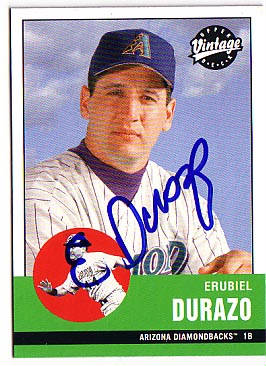
Former big league first baseman Erubiel Durazo, a Hermosillo native, will oversee the operations in his hometown.  Durazo spent 1999 through 2002 with Arizona before playing three more seasons in Oakland, for whom he hit a combined 43 homers with 165 RBI's in 2003 and 2004 (batting .321 his second year with the A's, good for fifth in the American League).  Durazo is translated as saying, "We're making history as an organization and as a country.  With the support of Sonora governor Claudia Pavlovich, the Diamondbacks look to be a 'Mexican' team, build the country's first Academy, then go look for other states." Espinoza writes the states of Sinaloa and Nuevo Leon are being considered for future academy sites.  Former D-backs' All-Star Luis Gonzalez, now a special Adviser to team CEO Derrick Hall, has been in Hermosillo setting up shop (including the naming of scouts) in preparation for the team office and academy.

The news may not being going over well in the Mexican League offices.  The LMB has had a virtual monopoly over teenage ballplayers in Mexico for decades by signing them at an earlier age than MLB teams are able to, then retaining their rights when they become old enough to play up north.  An informal blacklist of homegrown players who circumvented the system by waiting and signing directly with MLB teams instead was lifted earlier this winter, allowing expats to play in Mexico after their days in the USA or elsewhere are over.  The LMB also operates an academy in Carmen, near Monterrey in Nuevo Leon) while a similar facility exists in Oaxaca.

MLB vets Adrian and Edgar Gonzalez, along with their father David, opened the Gonzalez Sports Academy featuring Mexican-born baseball prospects near San Diego in 2010.  Prospects who signed with MLB organizations gave the GSA a 30% commission, far less than the 70% routinely paid to LMB teams for the same thing.  The facility shut down in 2012.

Sunday, February 20, 2011

GONZALEZ FAMILY PLANNING THREE ACADEMIES IN SINALOA

The family of MLB players Adrian and Edgar Gonzalez has released some details on three planned sports academies they would build and operate in the Mexican state of Sinaloa.

David Gonzalez, father of both players and himself a former member of Mexico’s national amateur team during his own playing days, told Fernando Ballasteros of Puro Beisbol that “High Performance Academies” are slated for Mexican Pacific League cities Mazatlan, Culiacan and Los Mochis. The facilities would be similar to the Gonzalez Sports Academy the family owns near San Diego.

As with the California facility, the Mexican academies will train aspiring athletes in basketball and volleyball as well as baseball. The elder Gonzalez says he’s already received support from Sinaloa governor Mario Lopez Valdez, and that ground has already been broken in Culiacan with a targeted opening later this year.

One party less than enthused about the project is the Mexican League, which operates similar academies near Monterrey and Oaxaca. While typically LMB teams keep 75 percent of the money any Mexican-born player get from signing with Major League teams (even those who, like Pirates prospect Luis Heredia, have never played an inning in the Liga) in what amounts to a monopoly of domestic players, the Gonzalez academies would keep only 30 percent of the proceeds. David Gonzalez is undaunted by LMB anger over potential competition for young Mexican talent: “We are happy to support the players and to recover the money we’ve spent will be enough.”